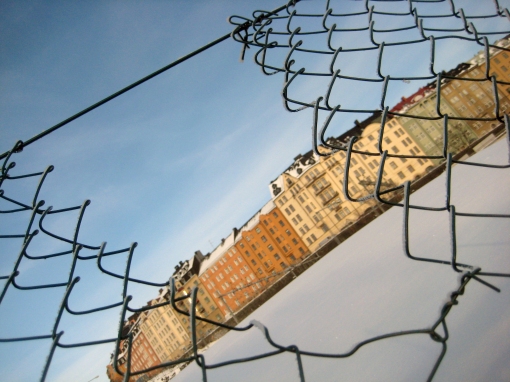
Viewing a row of buildings in the Vasastan neighborhood of Stockholm through a chain-link fence. Did the Incredible Hulk get here first?
Copyright Brett Ascarelli 2013.
January 26, 2013
Viewing a row of buildings in the Vasastan neighborhood of Stockholm through a chain-link fence. Did the Incredible Hulk get here first?
Copyright Brett Ascarelli 2013.
January 24, 2013
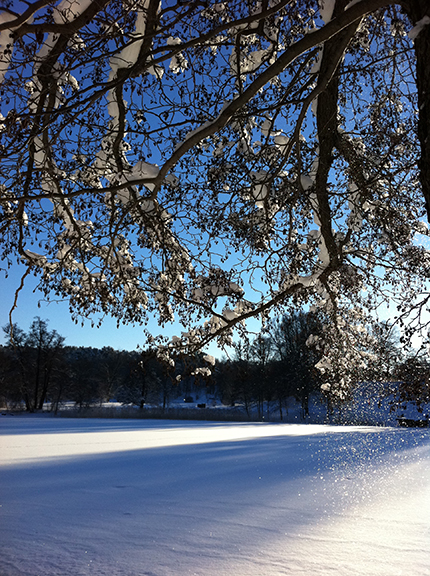
In this picture, taken across from Djurgården, the fairy dust is entirely compliments of the weather, not Photoshop.
Copyright Brett Ascarelli 2013
December 14, 2012
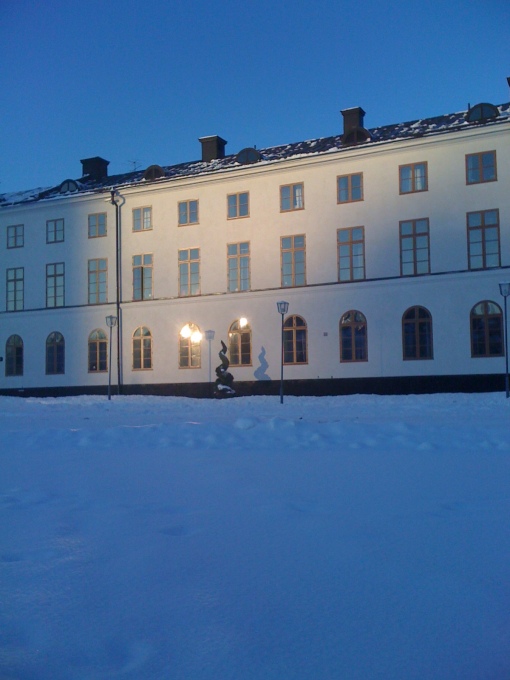
A view of Karlberg Palace in Stockholm, an hour or so before sunset.
Copyright Brett Ascarelli 2012
December 11, 2012

Because why shouldn’t photography – the delineation of light – help find the bright side of a Swedish winter? Pictured is the view from Strandvägen in Stockholm on 9 December 2012.
Copyright Brett Ascarelli, 2012.
November 11, 2012

A building in Stockholm bearing the imprint of what was once the adjoining building. Copyright: Brett Ascarelli, 2012.
Goofy paradoxes aplenty at this construction site made me do a double take.
Not only does a house, something one normally expects to be three-dimensional, lose nearly all its depth, but the inside of one building somehow becomes the outside of another: a facade accidentally gets caught wearing somebody else’s lingerie.
Essentially, demolition has flattened the house back to its original architectural elevation, life-sized and realized. And the effect is painterly and reminiscent of a dollhouse – not a few contemporary artists might imagine cutting the whole thing out and sticking it in a gallery.
While the poor leftovers of the house seem bare and honest, judging by looks alone it keeps its full history to itself. Sure, there are clues – the fire escape sign (which appears as a tiny green rectangle) over the door upstairs means people probably used the house as some kind of office. But could it have been built as a private house originally? And what about that little window to nowhere in the attic? Whose bust, if any, stood in the niche at the top of the stairwell?
It’s a pity it will get painted over.
Proposal: a generation of houses whose exterior walls reflect what’s inside – either via mixed-media murals in bas-relief, or giant architectural elevation stickers to affix to buildings. Any takers?
 mine is yours